.

Legal Developments in the World of Trademarks, Copyrights, Advertising and Beyond

Copyrights

Google v. Oracle: SCOTUS Sides with Google on Fair Use, But Is The Ruling Narrower Than It Seems?

April 19, 2021

by Connor J. Hansen and Stefan Szpajda

Download as a PDF

Share this page

On April 5, 2021, the Supreme Court issued its decision in Google v. Oracle, ruling 6-2 in Google’s favor on the issue of fair use. So ends a decade-plus battle between two tech giants that many viewed as having the potential to reshape how computer programs are written and licensed across the software industry. Google’s win—which is plainly indebted to the amici curiae who persuaded the Court of the policy rationale for a finding of fair use—thrilled those who saw a potential win by Oracle as an existential threat to settled norms in the software industry. Others have received the decision with skepticism, questioning how the Court could have blessed Google’s verbatim copying of Oracle’s code and struggling to reconcile the result with the plain text of the Copyright Act and established fair use precedent. Now, as the dust settles, those looking to Google v. Oracle for guidance on what they can and can’t do with proprietary software they don’t own must decide what, if anything, they can draw from its holding. The answer may prove elusive, and expensive.

We’ve followed this story since the Court first granted certiorari in 2019, with posts laying out the questions before the Justices, analyzing copyrightability and fair use, and summarizing oral argument. (For those new to the subject matter, these earlier posts will help you get up to speed on this complex case.) Now, in our final post in this series, we turn to the result.

Holding

Noting that Google v. Oracle does not “overturn or modify” earlier cases involving fair use, the Court held that Google’s re-implementation of a “user interface” (i.e., 11,500 lines of declaring code from 37 Java API libraries) owned by Oracle was a fair use of that material as a matter of law.

Justice Breyer wrote the majority opinion, joined by Justices Roberts, Sotomayor, Kagan, Gorsuch, and Kavanaugh. Justice Thomas dissented, joined by Justice Alito. Justice Barrett took no part in the decision.

The Majority Opinion

Although there were two questions before the Court, the majority ignored the first, making no express ruling on whether the declaring code at issue is copyrightable. As discussed below, this omission drew sharp criticism from the dissent, and is likely to exacerbate uncertainty over how the holding in Google v. Oracle should be applied. That said, the Court implicitly sided with Oracle on this question as fair use only comes into play if the underlying work is subject to copyright; the majority also acknowledged in several places that computer programs, including the declaring code at issue here, are “subjects of copyright.” This acknowledgement, however, only makes the majority’s silence on the first question before it more conspicuous and puzzling.

Instead of addressing copyrightability under 17 U.S.C. §§ 101 and 102, the majority devotes its opinion to an analysis of the fair use factors enumerated under 17 U.S.C. § 107, ultimately ruling that each one favors Google.

Factor 2: “The Nature of the Copyright Work.” Although this factor is actually the second fair use factor, for “expository purposes” the majority considered it first.

Under this factor, the majority compared declaring code and implementing code, and identified the attributes of declaring code that distinguish it from implementing code and—per the majority—weaken its protection under the Copyright Act. For example:

  • declaring code is “inextricably bound together” with the division of computing tasks that “no one claims is a proper subject of copyright;”
  • declaring code is “inextricably bound up” with the idea of organizing tasks in a manner that is not copyrightable;
  • declaring code is “inextricably bound up” with the use of commands, i.e., method calls, that Oracle did not claim were copyrightable; and
  • declaring code is “inextricably bound up” with implementing code, which Google did not copy from Oracle.

Although these observations were all made in the context of fair use, they track the arguments Google raised in objecting to the copyrightability of declaring code under the first issue before the Court. This, again, puts a spotlight on the majority’s decision to ignore the first issue before it, and invites the question of why it didn’t simply make these observations in that context. (More on that in our discussion of the dissent.) Further elaborating on the distinction between declaring code and implementing code, the majority concludes that declaring code “embodies a different kind of creativity” in that Oracle’s code was written to attract programmers by making it easy to remember and use.

Putting these ideas together, the majority observed that although both declaring code and implementing code are “functional in nature,” declaring code is “inherently bound together” with (1) uncopyrightable ideas (task division and organization) and (2) others’ new creative expressions, like Google’s Android implementing code. The majority thus ruled that the nature of declaring code weighs in favor of fair use.

Factor 1: “The Purpose and Character of the Use.” Here the majority considered whether Google’s use added “something new, with a further purpose or different character,” altering Oracle’s declaring code. First addressing traditional concepts derived from precedent to consider whether the use was “transformative” under this factor, the majority acknowledged that Google precisely copied the code at issue, and used it “in part” for the same purpose as Oracle. This would typically cut against Google, but the majority added that, in the context of computer programs, those cannot be reasons to rule against fair use because it would improperly limit the doctrine of fair use. Thus, the majority decided that Google’s purpose was to use declaring code created for use in desktop and laptop computers and apply it to smartphones. Although the majority stopped short of ruling that all such re-implementation of declaring code will weigh in favor of fair use under this factor, it observed that the record demonstrates that re-implementing declaring code in this manner “can further the development of computer programs.” In advancing this view, the majority cited the contributions of amici supporting Google, referencing briefs submitted by Copyright Scholars, Microsoft, Computer Scientists, R Street Institute, and American Antitrust Institute. The amici convinced the majority that Google’s use was transformative under this factor.

The majority also considered the commerciality and good faith of Google’s use, finding that Google’s commercial use was not dispositive in light of its “inherently transformative” use, and expressed skepticism regarding the role Google’s alleged bad faith should play in the analysis, choosing to give it no weight. The majority found this factor weighed in Google’s favor.

Factor 3: “The Amount and Substantiality of the Portion Used.” Google copied the declaring code for 37 packages of the Sun Java API, totaling approximately 11,500 lines of code. If considered in isolation, the majority acknowledged that would be a lot of copying. But the majority declined to consider it in isolation, and instead took into account the several million lines that Google did not copy in ruling that this factor weighed in Google’s favor.

Factor 4: “Market Effects.” Here, the majority declined to consider the market effects of Google’s copying by looking at the revenue Oracle lost as a result. Instead, the majority stressed Oracle’s poor position for success in the smartphone market, and weighed it against Oracle’s claim that Google’s copying harmed it. The majority also took into account whether Google’s copying produced “public benefits” related to the Copyright Act’s concern for the “creative production of new expression.” Significantly, the majority noted that a weighing of public benefit may not always be relevant, “not even in the world of computer programs.” But it nonetheless decided to weigh them here in determining the likely market effects of Google’s re-implementation.

Somewhat confusingly, in ruling against Oracle on this factor the majority reasoned that the success of a computer program may initially be attributable to its expressive qualities, but that over time it can instead become valuable “because users, including programmers, are just used to it.” Oracle had previously warned that a ruling in Google’s favor would effectively punish it for Java’s success. And although that may be a reductive summary of the decision overall, the majority’s reasoning here raises questions as to when the success of a copyrighted work shifts from its expressive qualities to the inertia arising from wide adoption, and why that should reduce its protection under the Copyright Act. Those wondering will find little comfort in the majority’s conclusion that “given programmers’ investment in learning the Sun Java API, to allow enforcement of Oracle’s copyright here would risk harm to the public.”

The Dissent

The dissent wasted no time before taking the majority to task for its failure to address the first question before the Court, i.e., whether declaring code is copyrightable. Noting that the majority “purports to assume, without deciding, that the code is protected,” the dissent concluded that the majority’s fair use analysis is “wholly inconsistent with the substantial protection Congress gave to computer code.” The implication here is that the majority sidestepped the first question because, had it fleshed out its position, the reasoning would have made its fair use analysis untenable. Per the dissent, “the majority purports to save for another day the question whether declaring code is copyrightable” because it “cannot square its fundamentally flawed fair-use analysis with a finding that declaring code is copyrightable.”

As to the nature of the work, the dissent rejected the majority’s attempt to distinguish implementing code from declaring code, noting that each observation made by the majority about implementing code is equally true of declaring code. The dissent added that “it makes no difference” that the value of declaring code depends on how much time third parties invest in learning it because “[m]any other copyrighted works depend on the same.” The dissent illustrates this point by analogy, explaining that although a Broadway musical script needs actors and singers to invest time learning and rehearsing it “a theater cannot copy a script—the rights to which are held by a smaller theater—simply because it wants to entice actors to switch theaters and because copying the script is more efficient than requiring the actors to learn a new one.”

The dissent also took a sharply different view of the market effects of Google’s copying, noting that whether or not Oracle could have built a smartphone on its own is only “half the picture” because Oracle could have licensed its software for use in Android. According to the dissent, Google’s copying destroyed that market for Oracle: “By copying Oracle’s work, Google decimated Oracle’s market and created a mobile operating system now in over 2.5 billion actively used devices, earning tens of billions of dollars every year. If these effects on Oracle’s potential market favor Google, something is very wrong with our fair use analysis.”

On the nature of Google’s use, the dissent accused the majority of conflating transformative use with derivative use, stressing that by the majority’s logic a movie studio’s unlicensed creation of a film based on a book would be transformative.

Finally, the dissent would find Google’s use substantial because it could serve as a “market substitute” for the original.

At bottom, the dissent rejects the majority’s view that there is a sufficient difference between implementing code and declaring code to render the former more protectable than the latter. The result of the Court’s ruling, per the dissent, is that it is now “difficult to imagine any circumstance in which declaring code will remain protected by copyright.”

Standard of Review

Many observers were surprised when, in 2018, the Federal Circuit reversed the jury’s 2016 finding of fair use, and Google argued that the appellate court applied the wrong standard of review by failing to give appropriate deference to the jury’s findings of fact. Google went so far as to argue that the Federal Circuit violated the Seventh Amendment’s right to a trial by jury, which raised eyebrows when it spurred a request for supplemental briefing from the Court.

But on these procedural questions, both the majority and dissent agreed with Oracle that the Federal Circuit applied the correct standard when it treated fair use as a mixed question fact of law. The Court held that appellate courts should defer to the jury on findings of underlying fact, and then consider de novo whether those facts support fair use. Although it made no difference to the outcome here, the Court’s ruling on these questions injects more uncertainty into future litigation by making appeals from a jury’s findings on fair use more viable than they would be had the Court sided with Google on this issue.

Where Do We Go From Here?

It is tempting to view the Court’s ruling as a clear win for software developers who want to re-implement portions of proprietary computer programs without a license—i.e., much of the software industry. But the holding may prove narrower and more uncertain than it appears. That’s because any fair use analysis necessarily mixes questions of fact and law, and is often—by design—uncertain. Indeed, the majority in Google v. Oracle stressed the doctrine’s “flexible” approach to the “sometimes conflicting” aims of copyright law, and that “its application may well vary depending upon context.”

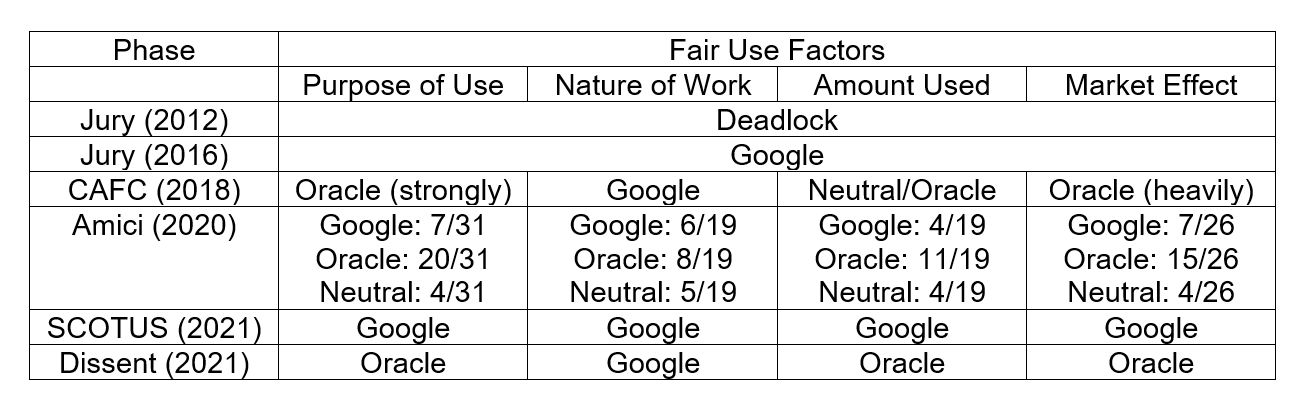
With the above in mind, consider the meandering path Google’s fair use defense took in this case. During the first trial in 2012, the jury deadlocked on fair use. In 2016, after a second trial on fair use, the jury found for Google. Then, in a rare move, the Federal Circuit reversed the jury’s finding and ruled that only one of four factors favored Google, with two of the four strongly or heavily favoring Oracle. Now, in 2021, the Supreme Court has ruled that the 2016 jury got it right, not only reversing the Federal Circuit but holding that every single fair use factor favored Google. The dissent, examining the same facts, found only one factor favored Google.

In addition, as illustrated in the chart below, the many amici who weighed in were split across factors. 39 amici addressed at least one fair use factor, but very few of the 39 addressed each of the four factors. The first factor was the most addressed factor, with 31 amici offering arguments relating to the purpose of the use, followed by the fourth factor with 26 amici addressing market effects. Although more amici argued in favor of Oracle for each of the fair use factors, the amici who argued for Google generally provided a deeper analysis of the issues relevant to fair use. This is because most Oracle-supporting amici who addressed fair use also addressed copyrightability, whereas many Google-supporting amici who addressed fair use devoted their entire briefs to fair use. Google-supporting amici also tended to focus on fewer factors, often just one or two factors, whereas Oracle-supporting amici tended to address three, if not all four, of the fair use factors. And the majority was clearly persuaded by Google-supporting amici, as it cited several of their briefs in its opinion.

Now imagine you’re a software developer who must decide whether Google v. Oracle clears the way for you to use another company’s proprietary code. How do you determine whether the code at issue is more like implementing code, which the Court did not include in its ruling on fair use, or declaring code? And assuming you can determine that the code is like the declaring code here, do you look at the result—the Court ultimately found fair use, and resoundingly so—and find comfort to proceed without a license? Or does the expensive and uncertain path of a fair use defense make you hesitant to take on that risk? After all, like Google, you may prevail, but the victory may cost more in legal fees than a license would have. Or, you might lose outright because the highly factual analysis cuts against you. For example, a court might find that your use of the code did not result in a sufficiently successful product to warrant a finding of fair use under Google v. Oracle, or that the code’s owner is better placed to compete in your market than Oracle was to compete in the smartphone market, and rule against you on that basis. Moreover, it should not be lost on anyone that Google spent many millions in legal fees, and the collective investment by the amici who filed briefs in support of Google was also significant. Query whether the same result would have been possible for a litigant without such resources to spare.

At best, in situations where the code in question is closely analogous to the declaring code at issue in Google v. Oracle, the Court’s ruling may support an efficient resolution finding fair use. But the line between implementing code and declaring code in Java—not to mention its analogues in other programming languages—may prove difficult to draw. And in those situations, Google v. Oracle is unlikely to provide the sort of certainty that can lead to efficient resolutions of copyright disputes.

Conclusion

The Court ruled that, under the doctrine of fair use, Google was free to use 11,500 lines of code from 37 Java API libraries owned by Oracle when Google programmed its Android platform. For Google, this means it will not be liable for potentially billions of dollars in damages. What it means for everyone else remains to be seen, and in light of the fact-intensive and context-specific premises behind the Court's ruling Google v. Oracle may prove narrower than it first appears.

Related Categories:

Copyrights

Firm Highlights

News

Dorsey & Whitney Advises Beijing Xunzhong on Two Consecutive H Share Placings Raising HK$418.5 Million

International law firm Dorsey & Whitney LLP acted as Hong Kong legal advisors to Beijing Xunzhong Communication Technology Co., Ltd. (“Xunzhong”) as to Hong Kong law in connection with two consecutive placings of new H shares under general mandate (the “First Placing” and the “Second Placing”, respectively, and together, the “Placings”). Xunzhong’s H shares are listed on the Main Board of the Hong Kong Stock Exchange (Stock Code: 2597). Winbull Securities International (Hong Kong) Limited acted as sole overall coordinator and placing agent on both Placings. The First Placing of 11,190,000 new H shares at HK$28.20 each was completed on September 17, 2026, followed by the Second Placing of 3,550,000 new H shares at HK$29.00 each on October 30, 2026. The Placings raised approximately HK$315.56 million and HK$102.95 million in gross proceeds, respectively, or approximately HK$418.51 million in aggregate (approximately HK$415.96 million in aggregate net proceeds). Both Placings were conducted under the same general mandate granted by shareholders at Xunzhong’s 2025 annual general meeting, and each was completed within one week of the signing of its placing agreement. Completing placings in consecutive months is relatively uncommon in the Hong Kong market, and doing so called on the technical depth of Dorsey’s Hong Kong Capital Markets team. Working closely with Xunzhong to understand its business needs and prepare the transaction documents, the team addressed in quick succession the remaining capacity under the general mandate, disclosure of the use of proceeds and the maintenance of Xunzhong’s public float, enabling both Placings to be completed seamlessly. “We are pleased to have advised Xunzhong on both Placings,” said Rachel Han, Partner and Co-Head of Dorsey’s Asia Capital Markets practice. “We appreciate the trust placed in our team and the close collaboration among all parties involved. We look forward to supporting Xunzhong as it continues to execute its growth strategy and pursue future capital markets opportunities.” Xunzhong is principally engaged in cloud-based communications services and enterprise digitalization services in the PRC. As disclosed in its announcements, the net proceeds of the First Placing are allocated to developing Xunzhong’s new computing power operation services business, while those of the Second Placing will be used to integrate model-as-a-service (MaaS) and AI agent capabilities into its existing cloud communications platform-as-a-service (PaaS) platform and software-as-a-service (SaaS) products. Approximately 55% of the net proceeds of the Second Placing will be used for computing power equipment upgrades for the MaaS system, approximately 35% for MaaS, PaaS and SaaS platform upgrades, and approximately 10% for working capital and general corporate purposes. With a single MaaS platform and shared computing power supporting its PaaS and SaaS offerings, Xunzhong intends for its MaaS, PaaS and SaaS capabilities to complement and reinforce one another, and to address customer needs from multiple angles, from embedding AI in customer communications and business workflows to maintaining stable performance at scale and keeping customer data within controlled environments. Partner and Co-Head of Dorsey’s Asia Capital Markets practice Rachel Han and Of Counsel in the Capital Markets and Corporate Compliance group Carlton Ng, along with Associate Kristy Ting, led the Dorsey Hong Kong Capital Markets & Corporate Compliance group in advising Xunzhong on both Placings.

Insights

Construing Congressional Silence: With the Natural Gas Act’s Not Addressing Compensation in Pipeline Condemnations, Can Courts Use State Law to Award Attorney Fees?

On November 9, 2026, the Supreme Court will hear oral arguments in Leonard W. Hoffmann v. WBI Energy Transmission, Inc. to determine: “In private condemnations under the Natural Gas Act, should just compensation be determined by reference to state law?” North Dakota ranchers litigated the price of a natural gas pipeline easement during three years of condemnation proceedings, settled on the easement price, and were awarded attorney fees based on state law, but the fees were denied by Eighth Circuit, which held that because the Natural Gas Act (“NGA”) provision authorizing pipelines to use of eminent domain does not address compensation, the Fifth Amendment standard must necessarily apply, that is, “just compensation” for property, but not attorney fees.1 Four other circuits disagree. The Court will resolve the circuit split, likely making some pipeline condemnations less expensive and quicker or, alternatively, more expensive and take longer. Whatever the result, Congressional action could follow. Background Section 7(c) of the NGA requires the Federal Energy Regulatory Commission (“FERC”) to issue a certificate of public convenience and necessity, before new interstate natural gas pipeline facilities can be constructed and operated.2 Significantly, only a private party – not the federal government, not a state, nor a municipality – can obtain certificate authorization.3 The NGA did not initially address property acquisition, leaving certificate holders to rely on state condemnation law to secure necessary property rights to develop their projects, rendering some with “only an illusory right to build.”4 Congress resolved that by enacting NGA Section 7(h), which vests certificate holders with the ability to exercise eminent domain in a federal or state court where the property is located.5 Yet Section 7(h) does not address compensation: it does not indicate whether attorney fees can be recovered; “it does not even expressly require that just compensation be provided.”6 Litigation over the meaning of the Congressional compensation silence ensued. After Years of Litigation, Parties Agreed on Easement Price, but Not Attorney Fees In February 2018, WBI Energy Transmission, Inc. (“WBI”) received certificate authorization to construct and operate approximately 12 miles of 24-inch diameter pipeline through ranch land in western North Dakota, in the heart of the oil and gas producing Bakken formation of the Williston Basin.7 WBI and the ranchers could not agree on an easement price: the ranchers had recently negotiated easement prices with oil pipelines (which do not have eminent domain rights and must pay “market” prices to obtain easements) and sought a similar deal,8 but WBI was unwilling, instead offering only what it paid for a parallel natural gas line easement years earlier.9 So WBI filed in federal district court a complaint to take by eminent domain a permanent easement and temporary rights-of-way to construct the pipeline. Shortly thereafter, with the agreement of the ranchers, the court ordered that WBI could have immediate use and possession of the easements necessary for construction, leaving for trial the amount of compensation.10 The Fifth Amendment guarantees that private property shall not be taken for public use without just compensation.11 WBI and the ranchers disagreed on what constitutes “just compensation.” WBI maintained that compensation should be determined solely by the “before and after rule” – i.e., the difference between the market value of the land free of the easement and the market value burdened with the easement.12 The ranchers argued that other factors should also be considered, such as market rate paid by oil pipelines for easements on the properties.13 WBI filed a motion in limine to exclude evidence and testimony of such payment information, which the trial judge denied,14 leading to a confidential settlement on the value of the easement, with the ranchers’ reserving their right to seek attorney fees and expenses and WBI’s reserving its right to contest. After three years of litigation, the ranchers sought to recover $383,375.76 – that is, $332,274.96 in legal fees and $50,650.86 in costs and expenses.15 WBI claimed that the amount was unreasonable and should be limited to $220,625.52.16 The trial court, recognizing that the NGA was silent on compensation issues, relied on United States v. Kimbell Foods, Inc.17 to analyze whether to “fill in the gap” with North Dakota condemnation law and ultimately concluded it could award attorney fees and costs.18 WBI appealed. Four Circuits Rely on Kimbell Foods and State Law to Award Attorney Fees Courts have recognized the difference between condemnations by the federal government and a private party: “the sovereign need only pay for what it actually takes rather than for all that the owner has lost.”19 “[W]here the federal government is the condemnor there exists a significant concern about the spending of federal dollars, one that does not exist when a private entity is the condemnor . . . pursuing the condemnation ‘for purposes of profit.’”20 As such, four circuit courts have applied federal common law to allow recovery of attorney fees and costs in condemnations under the NGA.21 “In crafting such federal common law, courts need not inevitably … resort to federal rules,”22 but rather, after weighing various considerations set forth in the Supreme Court’s 1979 opinion in Kimbell Foods, can apply state law.23 In particular, the four circuits answered “no” to each of the following three questions posed in Kimbell Foods: “(1) whether the federal program, by its very nature, required uniformity; (2) whether application of state law would frustrate specific objectives of the federal program; and (3) whether application of uniform federal law would disrupt existing commercial relationships predicated on state law.”24 The Eighth Circuit took a different tack. Eighth Circuit Reversed and Barred Attorney Fees, Breaking with Sister Circuits The Eighth Circuit framed the issue this way: “Under North Dakota law, as the district court points out, attorney fees are available in condemnation proceedings. WBI’s view is that federal law applies because it was exercising the eminent-domain power of the United States, which would owe no attorney fees if it did the condemning.”25 The court then held: “Just compensation” under the Fifth Amendment has a well-established legal meaning that usually equates to “market value,” the “full monetary equivalent of the property taken.” * * * But the focus is always on the value of the property itself, not what the owner spends trying to keep it. * * * Under the Fifth Amendment, property owners cannot recover for “indirect costs” like attorney fees and expenses. Only a statute can require more. * * * [T]he Natural Gas Act says nothing about the measure of compensation due to a property owner.  It does not even use the words “just compensation,” let alone say that attorney fees are available or that an agency or state law can provide them. Without such an exercise of “legislative grace,” the default rules applies: “just compensation” under the Fifth Amendment.26 The Eighth Circuit recognized “that different concerns are at stake when the United States is exercising its own power under the Fifth Amendment…. But these are policy arguments better addressed to Congress.”27 Petition For Writ of Certiorari Granted to Resolve Circuit Split The ranchers filed with the Supreme Court a petition for a writ of certiorari to resolve the split between the Eighth Circuit and four other circuits.28 WBI initially opposed the petition,29 but relented after the Solicitor General urged the court to grant petition and uphold the Eighth Circuit opinion.30 The attorneys general of ten states31 and a national network of eminent domain and property lawyers filed amici curiae (friends of the court) briefs in support of the ranchers’ petition.32 Shortly after WBI and ranchers filed supplemental briefs,33 the Supreme Court granted the petition for certiorari on June 26, 2026.34 Ranchers Focused on Statutory Interpretation, Six Amici on Economic Fairness Rather than rely primarily on Kimbell Foods, the ranchers’ merits brief used statutory interpretation to argue that private condemnation lawsuits under the NGA should use state law compensation rules.35 They contend that, in contrast to various ways that the federal government can take land,36 NGA Section 7(h) grants a limited “delegation of power to take property through a condemnation lawsuit – to file what is sometimes called “a straight condemnation,”37 where authorization to take property is not sought, but instead for the court to adjudicate the value of the property: “If the condemnor wants to buy the property at the court’s price, it tenders payment; if not, it can abandon the condemnation.”38 Thus, the ranchers submit that their rights to compensation under the NGA flow not from the Fifth Amendment, but rather from the NGA’s authorizing “the filing of a lawsuit whose purpose is to adjudicate how much they must be paid for their land.”39 If the condemnor were the federal government, compensation would not be greater than the Fifth Amendment minimum, absent statutory authorization;40 but that does not require the same to result in a private condemnation. The ranchers suggest that several additional reasons support using state law to resolve property compensation issues. First, given that real property law “lies at the core of traditional state authority”,41 compensation should consider “North Dakota’s rule that property owners cannot be made to bear the cost of their condemnation….”42 Second, based on the “Court’s longstanding practice of borrowing state substantive law,” the issue is not whether NGA Section 7(h) incorporates state land valuation rules, but “whether the statute preempts them.”43 Third, unless an easement’s value is above a statutory minimum,44 the condemnor can only file in state court: “If Congress expected those state courts to look to a source of law other than the one they would ordinarily look to in a property case, one could expect it to have left some hint to that effect in the text. But there isn’t one.”45 Fourth, awarding attorney fees under state law is consistent with the purpose of NGA Section 7(h): Respondent suggests that Congress, out of a desire to fix a problem in Missouri (where interstate natural-gas companies lacked an eminent-domain cause of action), also decided to take some money away from farmers and ranchers in places like Iowa (where the companies already had a cause of action). Surely not.46 Six groups filed amicus briefs supporting the ranchers.47 Among them, Florida property owners, who were involved in a different condemnation proceeding,48 contend that (1) compensation rules for federal government acting in its own name should not apply to private, for-profit companies acting under a limited delegation of eminent domain,49 and (2) “property owners who are without economic wherewithal proceed in an unrepresented fashion and are typically forced to accept a compromise close to the amount of the private licensee company’s low offers because they are not otherwise with the means to prepare their own valuation estimates and defend their respective constitutional entitlement to compensation.”50 This was reinforced by a group of property lawyers: In 2016, under the auspices of the Natural Gas Act (“NGA”), the Sabal Trail natural gas pipeline project in Florida took land from Ryan B. Thomas and offered him $6,800 in exchange. A Florida jury later determined that the measure of compensation for Sabal Trail’s taking was $463,439. Sabal Trail had thus initially offered Mr. Thomas 1.4% of his land’s value. Between the initial offer and the jury’s determination of compensation lay months of litigation work by Mr. Thomas and his attorney.51 The property lawyers also argued that affirming the Eighth Circuit’s decision would strip property owners of state law protections in 21 states.52 WBI Argued NGA Silence on Attorney Fees Intentional, Supported by Three Amici WBI’s merits brief contends that condemnation by a private party is nothing new and does not require a different set of rules from the Federal government’s condemning land: “For as long as the eminent domain power has been exercised by the United States, it has also been delegated to private parties.”53 These private delegatees “knitted together the expanding nation by building railroads, bridges, roads, and telegraph and telephone lines”54 and, absent a Congressional directive, paid the fair market value of the property taken, as required by the Fifth Amendment.55 WBI points to a 1943 case, United States ex rel. Tennessee Valley Auth. v. Powelson,56 which summarized then existing law: “[i]n the absence of a statutory mandate, the sovereign must pay only for what it takes, not for the opportunities which the owner may lose”.57 Indeed, Congress knew how to depart from the Fifth Amendment’s fair-market-value measure of condemnation compensation: “One year before enacting Section 717f(h), in the General Bridge Act of 1946, Congress authorized private parties to condemn land for bridges and expressly required that compensation ‘be ascertained and paid according to the laws of [the] State’ where the property sits.”58 Additionally, WBI argues that the ranchers essentially urge the court to adopt a patchwork of individual state compensation laws, which would undermine what Congress did in enacting NGA Section 7(h) --“eliminate state-by-state variation in NGA condemnations so that certificate-holders could efficiently construct interstate pipelines.”59 Three amicus briefs were filed in support of WBI, including one from the Attorney General, who reiterated: “Just compensation under the Fifth Amendment ‘is for the property, and not the owner. Accordingly, ‘indirect costs to the property owner caused by the taking of his land,’ such as ‘attorneys fees’ are ‘generally not part of the just compensation to which his is constitutionally entitled.’”60 Another amicus brief filed by trade associations claimed that interstate natural gas pipelines are responsible stewards of eminent domain, exercising it only as a last resort, as evinced by a survey indicating that, over a recent nine-year period FERC-certificated pipeline projects more than ten miles in length (25,268 tracts) resulted in only 10% of the tracts requiring condemnation and less than one percent (1%) required litigation.61 Finally, the US Chamber of Commerce emphasized the importance of natural gas to businesses,62 and urged the Court not to create obstacles that would “chill investment in essential infrastructure….”63 Crystal Ball Judicial Tension between “Strict Construction” and Support for Property Rights? Hoffmann could set up a clash between a favored method of the Supreme Court for resolving conflicts and a centuries’ long commitment to protecting a fundamental right. Questions during oral arguments could foreshadow which way the Court will lean. On one hand, the Court could rely on NGA Section 7(h)’s “’plain meaning’ derived from an ordinary understanding of the words and structure of the statutory text.”64 Consider the Supreme Court’s rationale in Dobbs v. Jackson Women’s Health Organization,65 which overruled the landmark Roe v. Wade:66 “The Constitution makes no reference to abortion, and no such right is implicitly protected by any constitutional provisions including . . . the Due Process Clause of the Fourteenth Amendment.”67 This type of “strict construction”68 aligns most closely with WBI’s argument that Section 7(h) does not specifically provide for attorney fees, and the silence was intentional, given that Congress expressly permitted recovery of attorney fees in eminent domain actions under the General Bridge Act of 1946, the year before enactment of NGA Section 7(h).69 On the other hand, the ranchers’ arguments resonate with a long line of cases protecting property rights. More than 130 years ago, the Court in Monongahela Nav. Co. v. U.S.70 explained that in condemnation cases the courts should adhere to “the rule that constitutional provisions for the security of person and property should be liberally construed.  A close and literal construction deprives them of half their efficacy, and leads to gradual depreciation of the right….”71 Half a century ago, the Supreme Court, in Lynch v. Household Fin. Corp,72 emphasized: “Property does not have rights. People have rights.”73 Three years ago, all nine justices, in Tyler v. Hennepin County, Minnesota,74 ruled for a property owner, holding that a local government cannot keep the surplus profit after selling a seized home for unpaid taxes.75 The policies in these (and other cases cited by the ranchers) would appear to support landowners’ recovering the costs incurred to defend their property in condemnation proceedings. Whether a strict construction of NGA Section 7(h) permits those policies to be realized in Hoffmann remains to be seen. Implications and Possible Congressional Action The amount of compensation offered by pipelines and the length of condemnation proceedings may change, depending on how the Supreme Court rules. If the Court upholds the Eighth Circuit opinion – and concludes that attorney fees and costs cannot be recovered –a landowner may be presented with an unsavory decision: accept the pipeline’s offer or, alternatively, refuse the offer, go to court, and watch legal fees erode any compensation ultimately received. Worse yet, with litigation unlikely, pipelines may submit “low ball” offers, believing that the landowner will not likely want to risk costly litigation. Conversely, if the Supreme Court reverses the Eighth Circuit and holds that attorney fees and costs can be recovered, the number of condemnation cases could increase, as landowners’ eyeing large payouts reject pipeline offers and take their chances in court. This in turn could increase pipeline costs (that are passed on to ratepayers). In short, depending on the Supreme Court rules, pipeline condemnations could become less expensive and quicker or, alternatively, more expensive and take longer. No matter how the Supreme Court rules, Congressional action could (and arguably should) follow. If the Eighth Circuit opinion is affirmed, Congress may be pressured to protect landowner property rights by amending NGA Section 7(h) to provide for the recovery of attorney and fees and costs. Under similar circumstances in 1954, Congress responded to an unpopular Supreme Court opinion on federal regulatory jurisdiction by amending the NGA.76 But even if the Eighth Circuit opinion is reversed, the result would be a geographical crazy quilt of federal common law stitched together from applicable state condemnation statutes, tying recovery of attorney fees in NGA condemnations to the state law in which the property is located, possibly leading to disparate cost recovery by landowners for the same pipeline project, prompting calls for a clear, uniform rule. 1 Click on the hyperlink in the body to access all motions and briefs submitted in the Supreme Court proceeding. 2 NGA § 7(c), 15 U.S.C. § 717(c)(1)(A) (“No natural-gas company … shall … undertake construction of extension of facilities … unless there is in force with respect to such natural gas-company a certificate of public convenience and necessity….). 3 Id. § 2, 15 U.S.C. § 717a (“’Natural-gas company’ means a person engaged in the transportation of natural gas in interstate commerce….; ‘Person’ includes an individual or a corporation.”). 4 PennEast Pipeline Co. v. New Jersey, 594 U.S. 482, 489 (2021). 5 NGA § 7(h), 15 U.S.C. § 717f(h), Pub. Law No. 80-245, 61 Stat. 459 (1947). Section 7(h), in pertinent part, provides: When any holder of a certificate of public convenience and necessity cannot acquire by contract, or is unable to agree with the owner of property to the compensation to be paid for, the necessary right-of-way to construct, operate, and maintain a pipe line or pipe lines for the transportation of natural gas, and the necessary land or other property . . . , it may acquire the same by the exercise of the right of eminent domain in the district court of the United States for the district in which such property may be located, or in the State courts. Id. 6 Tennessee Gas Pipeline Company, LLC v. Permanent Easement for 7.053 Acres, 931 F.3d 237, 243 (3d Cir. 2019). 7 Under FERC’s regulations, once issued a “blanket certificate,” an interstate natural gas pipeline may file a “prior notice” for certificate authorization to construct and operate facilities of limited cost, which, if not protested within 60 days after publication in the Federal Register, is authorized by operation of law. 18 C.F.R. § 157.205. On November 30, 2017, WBI filed a prior notice request to construct and operate certain facilities in McKenzie County, North Dakota; because no protests were filed, certificate authorization for the pipeline project was granted by operation of law. WBI estimated the project cost to be $27.2 million (WBI’s Prior Notice Request, Docket No. CP18-21-000 (Nov. 30, 2017) at 8), including $1,115,153 in pipeline right-of-way costs. WBI’s Supplemental Prior Notice Filing, Docket No. CP18-21-000, Exhibit K (Dec. 7, 2017) (Estimated Cost of Facilities). 8 “Leonard Hoffman was offered roughly half the market rate for gas pipeline access across his pastureland….” Chris Bennett, “Lowballed by Eminent Domain, ND Farmers Appeal Landmark Case to Supreme Court,” AG Web (Sept. 16, 2025) https://www.agweb.com/news/business/farmland/lowballed-eminent-domain-nd-farmers-appeal-landmark-case-supreme-court. 9 The pipeline at issue would run parallel to an existing pipeline on the ranchers’ land, which WBI uses to transport gas from the Wild Basin and Garden Creek processing plants to an interconnection with the pipeline system of Northern Border Pipeline Company. Brief of Respondent, Leonard W. Hoffman v. WBI Energy Transmission, Inc., No. 25-159 (filed Sept. 14, 2026) (“Respondent’s Brief”) at 7; id. (“Despite having earlier reached voluntary agreements for WBI’s immediately parallel pipeline at substantially lower rates, petitioners rejected WBI’s compensation offers.”) (citation omitted). 10 WBI Energy Transmission Inc. v. Easement and Right-of-Way Across, 189.9 rods, more or less, Case No. 1:18-cv-078, slip op. (D.N.D. May 7, 2018) (order adopting stipulation). 11 U.S. Const. amend. V (takings clause). 12 See United States v. 1129.75 Acres of Land, 473 F.2d 996, 998 (8th Cir. 1973) (“When land is taken by eminent domain, and the title acquired is not a fee, but merely an easement, the proper measure of damages is the difference between the market value of the land free of the easement and the market value burdened with the easement.”). 13 WBI Energy Transmission, Inc., v. Easement and Rights-of-Way Across 189.9 rods, more less, Case No. 1:18-cv-078, slip op. at 3 (D. ND, April 1, 2021) (Order Denying Plaintiff’s Motion in Limine to Exclude Evidence of Other Transactions). 14 Id. at 17 (“In this case, it may be appropriate for the fact finder to consider comparable pipeline easement transactions, particularly based on the unique natura of pipeline development in the Bakken oil field development occurring in McKenzie County, North Dakota.”). 15 The legal fees were “based upon a total of 1,295.4 hours, billed at hourly rates ranging from $115 to $350.” WBI Energy Transmission, Inc. v. Easement and Right-of-Way Across 189.9 rods, more or less . . . ., 2024 WL 1477719 (D. ND March 5, 2024). “The expenses include payments for court fees, travel expenses, legal research, and expert witness fees.” Id. 16 Each party and various amici curiae have expended considerable time and money to resolve the slightly more than $150,000 difference between the attorney fees and costs actually incurred ranchers and what WBI considered reasonable, underscoring that from the start this appeal has been about whether attorney fees should be awarded, not whether the ranchers’ attorney fees were reasonable. 17 440 U.S. 715 (1979). 18 WBI Energy Transmission, Inc., 2024 WL 1477719. 19 Tennessee Gas Pipeline, 931 F.3d at 244 (citations omitted); cf. Georgia Power, 617 F.2d at 1118 (“Thus by definition a licensed project does not implicate the interests of the United States to the degree that is thought desirable that the project be undertaken by the United States itself.”). 20 Tennessee Gas Pipeline, 931 F. 3d at 249 (citation omitted). 21 See Tennessee Gas Pipeline Company, LLC v. Permanent Easement for 7,053 Acres, 931 F.3d 237, 245 (3d Cir. 2019). The court explained: “Federal common law refers to the development of legally binding federal rules articulated by a federal court which cannot be easily found on the face of a constitutional or statutory provision.” The need for common lawmaking “stems from the inability of legislators to anticipate every possible contingency and the impracticality of judges[‘] returning all unanswered questions to the legislature.” Id. (citations omitted). The Third Circuit explained that “when Congress has not spoken in an area comprising issues substantially related to an established program of government operation, … the Supreme Court has direct[ed] federal courts to fill the interstices of federal legislation according to their own standards.” Id. (internal quotations and citations omitted). 22 Id. (citation omitted). 23 Id. The Supreme Court in Kimbell Foods was tasked with either crafting a uniform, national rule or, alternatively, utilizing state law, to determine whether contractual liens under federal loan programs take precedence over private liens. After establishing and applying a three-part test, the Court ultimately decided that nondiscriminatory state laws should be utilized. 440 U.S. at 740. The 3rd Circuit in Tennessee Gas Pipeline ruled that Kimbell Foods “and its progeny reflect a presumption in favor of state law, one not rebutted here.” 931 F.3d at 255. 24 The 5th Circuit applied Kimbell Foods first in a condemnation involving the Federal Power Act (Georgia Power Co. v. 138.30 Acres of Land, 617 F.2d 1112 (5th Cir. 1980)) and later in an NGA condemnation. Mississippi River Transmission Corp. v. Goerge S. Tabor, 757 F.2d 662 (5th Cir. 1985). The 6th Circuit (Columbia Gas Transmission Corp. v. Exclusive Natural Gas Storage Easement, 962 F. 2d 1192 (6th Cri. 1992), 3rd Circuit (Tennessee Gas Pipeline Co., 931 F. 3d at 245-46), and 11th Circuit also followed suit. Sabal Trail Transmission, LLC v. 18.27 Acres of Land in Levy County, 59 F.4th 1158 (11th Cir. 2023). The geographic footprint of each of these four circuits include significant oil and gas formations and, therefore, associated pipeline transportation systems: Third Circuit (Marcellus Formation), Fifth Circuit (Eagle Ford, Haynesville, and Permian Formations), Sixth (Devonian, Marcellus, and Utica Formations), and Eleventh Circuit (transmission from Marcellus and Utica Formations). These formations account for approximately 75% of the natural gas produced in the U.S. Ryan Bellafontaine, “Mapped: Where is U.S. Natural Gas Produced?” (Aug. 17, 2026) (Sources: EIA 2026) https://www.visualcapitalist.com/sp/sc02-mapped-where-is-u-s-natural-gas-produced/. 25 WBI Energy Transmission, Inc. v. 189.9 Rods, More or Less, 1332 F.4th 1058, 1060 (8th Cir. 2025). 26 Id. at 1060-61. 27 Id. at 1062. 28 Leonard W. Hoffmann v. WBI Energy Transmission, Inc., petition for cert. filed, No. 25-159 (U.S. Aug. 7, 2025) at 8-11. The petition was a long shot. Each year, the Court reportedly receives more than 7,000 petitions for a writ of certiorari, but only hears oral argument for 100 or less. Nora Collins, “The serious decline in petitions before the Supreme Court,” SCOTUS Blog (May 11, 2026) https://www.scotusblog.com/2026/05/the-serious-decline-in-petitions-before-the-supreme-court/. 29 WBI argued that “this case is a poor vehicle for review of the question presented” because North Dakota does not require, but merely allows the award of attorney fees (Brief in Opposition of WBI Energy Transmission, Inc. No. 25-159 (Oct. 2025) at 2) and urged the Court to wait and see if other courts agree with the 8th Circuit. Id. 30 Brief for the United States as Amici Curiae, No. 25-159 (May 22. 2026) at 2. 31 The ten states on brief included North Dakota, Alabama, Arkansas, Florida, Idaho, Indiana, Louisiana, Nebraska, South Carolina, South Dakota, Tennessee, and Texas. Brief of North Dakota, as Amici Curiae in Support of Petitioners, No. 25-159 (Sept. 8, 2025) at 4 (“just compensation” should be determined under state law because, among other things, the NGA “was not intended to displace traditional state authority for assessing real property value.”). 32 Owners’ Counsel of America as Amici Curiae in Support of Petitioners, No. 25-159 (Sept. 10, 2025) at 8 (presenting a survey showing that property owners in nearly half the states “would be stripped of their guaranteed rights if the Eighth Circuit’s choice-of-law analysis were adopted nationwide.”). 33 Respondent’s Supplemental Brief, No. 25-159 (June 8, 2026) at 1 (agreeing that cert should be granted, but “reserv[ing] the right to argue on remand, should it become relevant, that North Dakota law does not in fact include attorneys’ fees in the state’s measure of just compensation.”); Petitioners’ Supplemental Brief, No. 25-159 (June 5, 2026) at 2 (contrary to the Attorney General’s argument, requiring condemnors to pay for attorney fees would not incentivize landowners to draw out disputes to increase a potential fee award, any more than the status quo encourages condemnors to make unreasonable compensation offers). 34 https://www.supremecourt.gov/qp/25-00159qp.pdf; Sup. Ct. R. 16. (if a petition for certiorari is granted, “[t]he case then will be scheduled for briefing and oral argument.”). 35 The ranchers’ merits brief argues that the Kimbell Foods analysis leads to the same result as the statutory interpretation analysis. Brief of Petitioner, Leonard W. Hoffman v. WBI Energy Transmission, Inc., No. 25-159 (filed August 13, 2026) (“Petitioners’ Brief”) at 37-42. 36 Id. at 13-14 (unlike private parties, the federal government can take property by (1) seizing private property directly, leaving the owners to sue for compensation or (2) invoking the Declaration of Taking Act, where a condemnor takes immediate title to property, leaving compensation litigation for another day). 37 Id. at 14, citing Kirby Forest Indus., Inc. v. U.S., 467 U.S. 1, 3 (1984). 38 Petitioners’ Brief at 14. 39 Id. at 15. 40 Petitioners’ Brief at 15-16, citing Library of Congress v. Shaw, 478 U.S. 310, 317 & n.5 (1986). 41 Petitioner’s Brief at 17, quoting Sackett v. EPA, 598 U.S. 651, 679 (2023). 42 Petitioners’ Brief at 18; see also id. at 24 (arguing that, for nearly two centuries, Congress has known that the Supreme Court routinely interpreted federal claims by applying substantive state law), citing McCluny v. Silliman, 3 Pet. 270, 276, 278 (1830 (applying state limitations period to plaintiff’s rights under federal law). 43 Petitioners’ Brief at 26; see Agency Holding Corp. V. Malley-Duff & Associates, Inc., 483 U.S. 143, 158 (1987) (Scalia concurring). Thus, for example, “congressional silence on the [statute of] limitations issue is ordinarily insufficient to pre-empt state statutes….” Agency Holding Corp., 483 U.S. at 162. 44 See NGA § 7(h), 15 U.S.C. § 717f(h) (“the United States district courts shall only have jurisdiction of cases when the amount claimed by the owner of the property to be condemned exceeds $3,000.”). 45 Petitioners’ Brief at 29. 46 Id. at 32. 47 Six amicus briefs supporting the ranchers were filed on August 13, 2026 in Leonard W. Hoffman v. WBI Energy Transmission, Inc., No. 25-159: Brief of Florida Property Owners Ryan Thomas, Lee Thomas Trust, and Sunderman Groves, Inc. (“Florida Property Owners Brief”); Brief of Gary R. Erb and Lynda Like (“Pennsylvania Property Owners’ Brief”); Brief of Owners Counsel of America (“Owners Counsel Brief”); Brief of Landowner Groups, (“Landowner Groups’ Brief”); Brief of Pacific Legal Foundation (“PLF Brief”); Brief of National Association of Realtors, American Farm Bureau Federation, and Realtors Land Institute (“Realtors Brief”). 48 The Florida property owners report that ten years ago Sabal Trail Transmission, LLC (“Sabal Trail”) filed 263 condemnation cases in federal courts for a 247-mile corridor to construct a 36-inch pipeline to transport 1 Bcf/day. Florida Property Owners Brief at 13-14. In August 2026, the Florida property owners received notice that Sabal Trail is evaluating expansion pipeline project running near or along the current route for 482 miles, (id. at 14) increasing the stakes at issue in Hoffmann. 49 Id. at 8-9 (“Federal actors are ultimately accountable to federal officials, sworn to uphold the Constitution, charged with promoting the public good, and held accountable by the voters on Election Day. * * * And, in direct federal condemnations, the federal government retains a continued ownership interest in the property taken . . . .”); see Pennsylvania Property Owners’ Brief” at 2 (while NGA § 7(h) delegates the power to condemn, “it does not transfer every rule or governmental protection that accompanies condemnation by the United States.”); id. at 7, citing U.S. v. Carmack, 329 U.S. 230, 243, n.13 (1946) (distinguishing federal officers acting for the sovereign from private entities authorized to condemn “on behalf of themselves”, whose grants “are, in their very natural grants and of limited powers” that “do not include sovereign powers greater than those expressed or necessarily implied.”). 50 Florida Property Owners’ Brief at 4; id. at 5 (for private licensee companies exercising eminent domain rights under the NGA, “the Fifth Amendment’s measure of compensation should serve as a floor and not a ceiling” -- to do otherwise, “state created rights to attorneys’ fees will be stricken in six of the seven states of the Eighth Circuit, and will be at serious risk in at least 15 other states if the Eighth Circuit’s new-fashioned split widens.”). 51 Owners Counsel Brief at 2 (internal citations omitted). “In the Sabal Trail pipeline litigation, condemnors spent a combined $8.3 million on appraisal work alone across the project.” Id. at 6 (citation omitted); see also Landowner Groups’ Brief at 5 (“The Eighth Circuit’s decision threatens to alter that bargaining framework well before any condemnation proceedings begin. If a company exercising eminent domain … may disregard state compensation protections and pay only the federal constitutional minimum, its fallback position becomes less costly, changing the baseline against which voluntary easement negotiations occur.”). 52 Owners Counsel Brief at 10-17 (list of 21 state statutes providing condemnation protection); see PLF Brief at 4 (distinguishing cases relied on by the 8th Circuit); see also Realtors Brief at 5 (cautioning that the 8th Circuit’s reasoning could incentivize “advocates for more public control of private interests….”) (citation omitted). 53 Respondent’s Brief” at 2, quoting PennEast, 594 U.S. at 495; see Respondent’s Brief at 2, quoting Luxton v. North River Bridge Co., 153 U.S. 525, 530 (1894) (Congress “may at its discretion, use its sovereign powers, directly or through a corporation * * * for the accommodation of interstate commerce.”). 54 Respondent’s Brief at 4. 55 Id. at 2, United States v. Miller, 317 U.S. 369, 374 (1943) (“[T]he courts early adopted, and have retained the concept of fair market value” as the appropriate compensation); United States v. New River Collieries Co., 262 U.S. 341 344 (1923) (“More would be unjust to the United States, and less would deny the owner what he is entitled to.”). 56 United States ex rel. Tennessee Valley Auth. v. Powelson, 391 U.S. 266 (1943). 57 319 U.S. at 281-82. 58 Respondent’s Brief at 2, quoting 33 U.S.C. § 532. 59 Respondent’s Brief at 28 (citation omitted). 60 Brief for the United States, Leonard W. Hoffman v. WBI Energy Transmission, Inc., No. 25-159 (filed Sept. 21, 2026) at 12 (citations omitted). The Attorney General also noted that the Supreme Court had recently ruled that eminent domain power delegated to a certificate holder is “categorical,” that is, absolute and unconditional. Id. at 10, citing PennEast Pipeline Co., 594 U.S. at 498. 61 Brief of the Interstate Natural Gas Association of America and American Petroleum Institute, Leonard W. Hoffman v. WBI Energy Transmission, Inc., No. 25-159 (filed Sept. 21, 2026) at 11. “INGAA” is the natural gas pipeline trade association, while “API” represents all aspects of the oil and gas industry. Id. at 1. 62 Brief of the Chamber of Commerce of the US, Leonard W. Hoffman v. WBI Energy Transmission, Inc., No. 25-159 (filed Sept. 21, 2026) at 4-6. 63 Id. at 9. 64 Bradley C. Karkkainen, “Plain Meaning”: Justice Scalia’s Jurisprudence of Strict Statutory Construction,” 17 Harv. J.L. & Pub. Pol’y 401 (1994). 65 597 U.S. 215 (2022). 66 410 U.S. 113 (1973). 67 Id. at 231. 68 See id. at n.9 (strict construction “refers to a construction that narrows the scope of coverage or application of a statute….”). 69 See West Virginia v. EPA, 597 U.S. 697, 723 (2022) (“We presume that ‘Congress intends to make major policy decisions itself, ….”) (citation omitted). In applying the “major question doctrine,” the Court explained: “The question there [American Elec. Power. Co. v. Connecticut, 564 U.S. 131 (2011)] however, was whether Congress wanted district court judges to decide, under unwritten federal nuisance law, ‘whether and how to regulate carbon dioxide emissions from powerplants. We answered no….”’ 597 U.S. at 731. Another reason supports the efficacy of WBI’s argument: the Roberts Court has been labeled “business friendly,” with business winning on average 71% of the cases before the Supreme Court from 2010-20. Lee Epstein and Mitu Gulati, “A Century of Business in the Supreme Court, 1920-2020,” 107 Minn. L. Rev. 49, 59 & n.36-37 (2022). 70 148 U.S. 312 (1893). 71 Id. at 325. The Court concluded that if the government condemns a series of locks and dams built by a company to make a river navigable, whose passage is compensated with tolls, it must compensate a company not just for the value of the tangible property, but also for the franchise to take tolls. Id. at 344-45. 72 405 U.S. 538 (1972). 73 Id. at 552. After lower courts allowed a credit union to seize a woman’s savings account (without notice) for failure to repay a loan, the Court remanded and explained: “The right to enjoy property without unlawful deprivation, no less than the right to speak or the right to travel, is in truth a ‘personal’ right ….” Id. (emphasis added). 74 598 U.S. 631 (2023) (J. Gorsuch and J. Jackson concurring). 75 After Hennepin County sold her condominium $40,000 to satisfy a $15,000 tax bill and kept the surplus, a 94-year-old woman filed claims (under the takings clause of the Fifth Amendment and Excessive Fines Clause of the 8th Amendment) against the county, which the trial court dismissed for failure to state a claim, and the 8th Circuit affirmed. 598 U.S. at 635-36. In a companion case, Sackett v. EPA, 598 U.S. 651 (2023), landowners wanting to build a house used sand and gravel to fill in a lot next to a ditch, but the Environmental Protection Agency (“EPA”) considered their land protected wetlands under the Clean Water Act, told the landowners that they could not build, directed them to remove the sand and gravel or face $40,000/day fines. Id. at 662. The Supreme Court reversed the underlying opinion siding with the EPA and limited the scope of the “waters of the United States,” allowing the landowners to build their house. Id. at 684. 76 NGA § 1(c), P.L. 83-323, 68 Stat. 36 (1954) (exempting from federal regulation natural gas companies operating entirely within a single state, effectively overturning FPC v. East Ohio Gas Co., 338 U.S. 464 (1950) that had ruled an otherwise local, in-state gas company was subject to federal regulation because it crossed state lines to receive gas).


Event/Resource

Corporate Counsel Symposium 2026 Materials Hub

Materials Symposium Agenda Sessions 8:30 am - 9:30 am CT Session A: The Corporate Compass: Finding True North When Ethical Duties Conflict Philip Kaplan, Senior Legal Counsel, Howden Re Lucia Suljic, Vice President, Corporate Legal, Canon USA Nicole Stanton, Partner & Deputy General Counsel, Dorsey & Whitney LLP This panel addresses ethical obligations of in-house counsel, including balancing obligations and duties that may conflict with each other. How should a responsible in-house lawyer deal with those challenging situations? Rather than stick to an academic discussion, this panel will revolve around a series of practical scenarios that are designed to be realistic and timely, including situations where counsel is asked to represent both the company and an individual, how and when to disclose uncomfortable facts and inconvenient documents, issues involving changing firms and companies, and multijurisdictional practice. The panel will feature discussion from two experienced in-house lawyers and Dorsey’s Deputy General Counsel. Session B: Managing Rapid Regulatory Change in International Trade and Cross-Border Investment Nathan Brower, Executive Vice President, General Counsel, Nature’s Sunshine Greg Ogunsanya, Senior Vice President, General Counsel and Corporate Secretary, H.B. Fuller Kathryn Wood, Senior Vice President & General Counsel, DecoPac, Inc. Dave Townsend and Lawrence Ward, Dorsey & Whitney LLP This program is designed for attorneys advising on cross-border transactions, international trade, regulatory compliance, and corporate governance matters. Panelists will examine recent developments in U.S. trade and investment law and policy, as well as their impact on international collaborations, corporate compliance, and mergers and acquisitions. The discussion will explore how general counsel and in-house legal teams assess and manage evolving trade-related risks within their organizations. Particular focus will be given to developments during the first two years of the second Trump Administration, including changes in tariff policy, tariff refunds, export controls, economic sanctions, and national security reviews of foreign investment. Through a discussion of regulatory trends and practical case studies, attendees will gain a deeper understanding of the legal risks and compliance obligations associated with cross-border business activities, and hear about practical strategies for advising clients and managing compliance obligations in a rapidly changing trade and investment environment. 9:45 am - 10:45 am CT Session A: The Elon Musk Cases: What Tesla and Twitter Can Teach Your Board of Directors Loren Unterseher, Managing Partner, Oxbow Industries, LLC Shulamite White, Chief Legal Officer and Head of People, Motive Technologies Kirsten Schubert, Tom Swigert, and Jonathan Van Horn, Dorsey & Whitney LLP Recent cases involving Elon Musk and his businesses have had significant impact on principles governing board of directors’ fiduciary duties and corporate processes. This panel will examine recent litigation involving Elon Musk, Tesla, and Twitter, and its effects on the law governing the duties of directors and executives, including the executive compensation and director compensation processes, conflicts that may arise when a single executive has control over multiple businesses, and the ramifications of tweets or other public statements by an executive. Session B: All Eyes on DEI: Managing Diversity Efforts Amid Regulatory Scrutiny and Potential Litigation Maggie Dalton, Senior Commercial Attorney, Cargill; Board Co-Chair, Twin Cities Diversity in Practice Laura A. Vannelli, Legal Counsel, Mayo Clinic Susan Lorenc and Jack Sullivan, Dorsey & Whitney LLP The legal and regulatory landscape surrounding diversity, equity, and inclusion (DEI) initiatives has changed dramatically over the past two years. Law firms and legal departments are continuing to grapple with how to recruit, retain, and develop talent from a wide range of personal backgrounds, in a world where previously accepted recruiting and employment practices are facing increased scrutiny and litigation. This program will provide a practical overview of the current legal regime, including recent federal enforcement actions and litigation trends associated with DEI initiatives. Panelists will discuss practical ways in which organizations can pursue and retain legal talent and increase inclusion while minimizing legal, business, and reputational risk. 11:00 am - 12:00 pm CT Session A: Governance in an Age of Increasing Unpredictability James Chosy, Senior Executive Vice President and General Counsel, U.S. Bancorp Todd Hartman, Executive Vice President and Chief Legal and Risk Officer, Best Buy Co., Inc. Alan Rosselot, Associate General Counsel & Assistant Secretary, Delta Air Lines, Inc. Cam Hoang and Robert Rosenbaum, Dorsey & Whitney LLP More than ever, ensuring that boards are well-informed and forward-thinking is critical to a company’s success. Join our panel of corporate governance experts as they share their experiences advising boards through crisis and unpredictable events; capitalizing on, but also checking, disruptive technologies; and positioning the company to succeed in an environment of shifting government priorities. Session B: A Day in the Life of a Trademark, Copyright & Advertising Attorney: A Hypothetical Case Study Alexander Kim, Vice President and General Counsel, Binks Nate Whitaker, Chief Legal Officer and General Counsel, Crumbl Cathy Dahl and Tiffany Shimada, Dorsey & Whitney LLP What issues are companies facing daily while developing rights in intellectual property, protecting those rights, and staying in compliance with myriad potential issues related to advertising, social media, relationships with influencers, and environmental or governmental claims? This panel will feature two in-house counsel who are navigating these issues, utilizing a hypothetical case study, with the support of two Dorsey attorneys helping to develop a roadmap for meeting business objectives and minimizing the risk of claims. 12:00 pm - 1:15 pm CT Keynote Address Dr. Rebecca Heiss, Stress Physiologist Dr. Rebecca Heiss is a stress physiologist, author, and sought-after speaker who helps audiences transform fear and stress into fuel for greater performance and resilience. Her research has been recognized as “transformative” by the National Science Foundation, and she is the author of two books, Springboard and Instinct. Through her Fear(less) message, Rebecca inspires audiences with practical, science-based strategies to train our brains to work for us – not against us – and navigate change and uncertainty with greater confidence.

Insights

The Methane Regulatory Pendulum Swings Again: EPA Proposes Sweeping Changes to Federal Standards for the Oil and Natural Gas Sector

Few environmental regulations better illustrate Washington’s regulatory “ping-pong” than EPA’s methane standards for the oil and natural gas sector. Over the last decade, successive administrations have repeatedly expanded, narrowed, rescinded, reinstated, and revised federal methane requirements, leaving industry to navigate a shifting compliance landscape with each change in administration. EPA’s October 27, 2026 proposal to reconsider significant portions of the 2024 oil and natural gas New Source Performance Standards (“NSPS”) and Emission Guidelines (“EG”) under Subparts OOOOb and OOOOc represents the latest swing of the regulatory pendulum. If finalized, the proposal would substantially reduce compliance obligations in several areas, particularly with respect to lower-producing wells, associated gas flaring, equipment and control-device standards, and the Super Emitter Program. EPA estimates that the proposal would result in approximately $45 billion in savings, while preserving what the agency considers appropriate methane emission controls. EPA’s proposal was published in the Federal Register on October 29, 2026. Comments must be received on or before December 16, 2026.  Significantly, EPA is not using this rulemaking to reconsider its general authority to regulate methane emissions from the oil and natural gas sector. Rather, the agency is addressing specific requirements adopted in the 2024 methane rule, while broader questions concerning greenhouse gas regulation are being addressed in separate proceedings. The present proposal therefore focuses on the appropriate design and scope of particular methane regulations, rather than resolving the threshold question of whether methane may be regulated under the Clean Air Act at all. I.    EPA Proposes to Eliminate the Super Emitter Program Among the proposal’s most consequential changes is the complete elimination of the Super Emitter Program. Adopted in 2024, the program created a regulatory framework under which EPA-certified third parties could identify large methane releases using approved remote-sensing technologies. Upon receiving a qualifying notification from EPA, owners and operators were required to investigate the reported emissions event, report findings to EPA, and take corrective action where necessary. EPA now proposes to repeal the Super Emitter Program in its entirety. The agency questions the program’s legal and policy foundations, including the role of third parties in identifying emissions events and triggering regulatory obligations. EPA also questions whether the program is necessary or effective given other requirements applicable to regulated sources and whether its expected emissions reductions justify its costs and implementation challenges. Because the program was incorporated into both the NSPS applicable to new, modified, and reconstructed sources and the EG applicable to existing sources, its removal would affect federal requirements as well as the presumptive requirements that States otherwise would be expected to address in Clean Air Act § 111(d) plans. Importantly, EPA’s proposed repeal does not prevent States from developing and implementing their own Super Emitter Program based on the existing requirements, which several states are already doing.  II.    EPA Reconsiders Associated Gas Requirements Another centerpiece of EPA’s proposal is its reconsideration of the 2024 rule’s restrictions on flaring associated gas from oil wells. The 2024 rule determined that the best system of emission reduction (“BSER”) generally required operators to capture and beneficially use associated gas by routing it to a sales line, using it onsite, or reinjecting it, rather than routinely flaring it. Although EPA provided certain transition periods and compliance flexibilities, particularly for wells facing infrastructure constraints, the rule ultimately established a framework strongly favoring capture and utilization over flaring. Since promulgation, EPA has received significant feedback regarding gathering-system limitations, gas quality issues, and other practical barriers operators face in securing outlets for associated gas. In response, EPA proposes to replace the existing capture-focused approach with a substantially more flexible standard. EPA argues that the 2024 rule relied too heavily on the availability of third-party gathering and processing infrastructure that is often beyond an operator’s control, raising questions regarding achievability and cost-effectiveness. Under the proposal, BSER would be based on routing associated gas to a flare or other control device capable of achieving at least a 95 percent reduction in methane and volatile organic compound (“VOC”) emissions. Operators could continue to capture gas for sale, use it onsite, or reinject it where feasible, but those practices would no longer be required. EPA also proposes that if a portion of associated gas is routed to sales or used for another purpose, the remaining portion must comply with the 95 percent standard. For example, if a company can route 40 percent of its associated gas to a sales line, the company would need to route the other 60 percent to a control device with a 95 percent reduction, or to a flare. EPA is also soliciting comment on less sweeping alternatives that would preserve the basic structure of the 2024 associated-gas program, while providing additional compliance flexibility. In particular, EPA requests comment on whether it should retain the current capture-and-sales framework but expand the circumstances under which temporary flaring is permitted or extend the duration of temporary flaring allowances where operators face infrastructure constraints. EPA appears to recognize that gathering-system availability, processing constraints, and other third-party factors can affect an operator's ability to route gas to sales, even where the operator ultimately intends to comply with the capture requirements. These requests for comment suggest that EPA is considering whether targeted revisions to the existing framework could address implementation concerns without fully abandoning the 2024 rule's underlying preference for gas capture and beneficial use. III.    EPA’s Reconsideration of the “No Identifiable Emissions” Standard EPA's proposal would substantially revise the 2024 rule’s “no identifiable emissions” (“NIE”) requirements applicable to certain covers and closed vent systems (“CVS”) associated with storage tanks. Under the existing rule, covered equipment generally must operate without identifiable emissions, creating a compliance framework that focuses heavily on the absence of observable emissions rather than solely on equipment design or overall control effectiveness. Since promulgation, industry has argued that the standard effectively functions as a zero-emissions requirement that may be difficult to satisfy under all operating conditions, even where equipment and vapor control systems are properly designed, maintained, and operated. Moreover, EPA stated in the preamble to the 2024 rule that any identified emissions would constitute a deviation of the emissions limitation, resulting in a framework under which the observation of emissions could itself establish noncompliance. EPA now proposes to separate the requirements into distinct design and operational components and to fundamentally alter how compliance with the operational NIE requirement is evaluated. EPA proposes to distinguish between deviations of the design requirements and deviations of the operational NIE requirements. Under the proposed approach, failure to repair an identified emission or defect within 24 hours would constitute a deviation of the design requirement, although not necessarily an underlying violation. Separately, operators could demonstrate compliance with the operational NIE requirement by making repairs as soon as practicable, with an initial repair attempt within five days and final repair within 30 days, or by qualifying for the existing delay-of-repair provisions. A deviation of the operational requirement would occur if the applicable repair deadlines are not met and the delay-of-repair provisions do not apply. The proposal also establishes a new framework for addressing recurring or “chronic” emissions events. After the third emissions event or defect from the same cover or CVS within a year, the owner or operator would be required to conduct an investigative analysis within 10 days to determine whether the underlying cause relates to equipment design, operation, maintenance, or prior repair efforts. The results of that investigation would have important compliance implications. If recurring emissions are attributable to a design flaw, EPA would treat the issue as a deviation of the design requirements. If the emissions result from inadequate prior repairs, the deviation would be attributed to the repair requirements. If operations, maintenance, or other site practices are responsible, the deviation would be classified under the operational requirements. EPA would also require implementation of corrective measures identified through the analysis, including design modifications within 90 days and operational or maintenance-related corrective actions within 30 days. Taken together, these revisions would shift the NIE standard away from a framework in which the mere presence of emissions may establish noncompliance and toward one that focuses on whether operators identify emissions, complete timely repairs, investigate recurring problems, and address the root causes of repeated emissions events. IV.    Solicitation of Comment on “Legally and Practicably Enforceable” Standard EPA is also soliciting comment on the definition of “legally and practicably enforceable” (“LPE”), which industry has identified as one of the more problematic existing requirements. Under the 2024 rule, EPA adopted an interpretation of LPE that many commenters argued effectively disqualifies numerous state regulatory programs, permits, and other federally enforceable mechanisms from serving as the basis for remaining below applicable Subpart OOOOb storage tank thresholds. In particular, stakeholders have asserted that the current LPE framework makes it difficult for state air permitting programs and other state regulatory requirements to satisfy EPA's criteria, thereby causing more storage tanks and other emission units to remain subject to Subpart OOOOb requirements than would otherwise be the case. EPA now requests comment on whether its current interpretation of LPE is overly restrictive and whether alternative approaches would better account for the manner in which state permitting and regulatory programs are administered and enforced. The request is significant because a broader interpretation of LPE could allow a wider range of federally enforceable state permits and regulatory requirements to satisfy exemption criteria under OOOOb, potentially reducing the number of storage tanks and other sources subject to direct NSPS regulation. As a result, the LPE issue has implications that extend beyond compliance mechanics and could materially affect the scope of sources regulated under the federal methane program. V.    Revised Requirements for Marginal Wells EPA is also proposing significant revisions to the treatment of lower-producing wells under Subparts OOOOb and OOOOc. The agency notes that marginal wells constitute a substantial portion of the nation’s producing well inventory but account for a relatively small share of overall production. At the same time, EPA discusses studies estimating that marginal wells contribute a disproportionate share of methane emissions from oil and natural gas production. The agency is evaluating whether the 2024 rule appropriately accounts for the operational characteristics, emissions profiles, and compliance costs associated with these wells. To address those concerns, EPA is proposing two alternative approaches to well-site subcategorization. Under the first option, EPA would distinguish between marginal and non-marginal well sites. EPA proposes to define a marginal well as a well that produced no more than 15 barrels of oil equivalent (“BOE”) per day over the prior 12-month period and a marginal well site as a site consisting exclusively of marginal wells with total site-wide production of no more than 15 BOE per day over the same period. EPA is also soliciting comment on whether marginal wells should be further subdivided based on production levels, including a potential distinction between sites producing 6 BOE per day or less and sites producing more than 6 BOE but no more than 15 BOE per day, which could result in additional regulatory flexibility for the lowest-producing wells. Under the second option, EPA would distinguish between conventional and unconventional well sites and tailor requirements based on that classification, including reduced requirements for conventional wells. The agency is seeking comment on which framework better reflects the operational and emissions characteristics of different well sites, as well as whether additional subcategories should be established within the marginal-well population and the extent to which compliance requirements should differ among categories. VI.    LDAR, Pneumatic Controllers, Control Device Monitoring, and Facility Modifications EPA's proposal also includes several targeted revisions to the 2024 rule's leak detection and repair (“LDAR”) requirements. Most notably, EPA proposes additional flexibility in the use of advanced monitoring technologies and seeks to move away from compliance frameworks that rely heavily on a single detection method. The agency is proposing changes intended to facilitate the use of multiple monitoring technologies, including optical gas imaging and other alternative detection approaches, and is seeking comment on whether technology-neutral compliance options can achieve equivalent emissions reductions at lower cost. EPA also proposes revisions for components and equipment that are particularly difficult to monitor using conventional LDAR methods, reflecting concerns that certain 2024 requirements may not be practical or cost-effective in the field. More broadly, EPA questions whether some of the monitoring frequencies adopted in 2024 appropriately balance compliance burdens and emissions-reduction benefits and seeks comment on additional opportunities to tailor LDAR obligations based on emissions risk and source characteristics. EPA also proposes technical revisions to requirements governing control devices and related equipment. These include changes addressing continuous pilot-flame requirements, flame-monitoring data deviations, control-device alerts, visible-emissions test conditions, temporary or backup control devices, temporary process controllers, and control-device categories. The agency’s stated objective is to provide additional compliance flexibility while maintaining appropriate emissions controls. The practical effect will depend on the final requirements and the equipment and circumstances to which each amendment applies. The proposal also addresses pneumatic controllers and equipment leaks at gas processing plants. For certain high-pressure process controllers at transmission compressor stations, EPA proposes a separate regulatory approach based on its reassessment of technical feasibility and cost. The proposal should not be read as establishing a general exemption for pneumatic controllers across the industry. EPA also proposes changes to other equipment-specific requirements, including requirements applicable to pumps, storage vessels, and equipment leaks at gas plants, in response to concerns raised following promulgation of the 2024 rule. Finally, EPA proposes changes to certain requirements governing liquids unloading and other well-site operations, as well as technical corrections and clarifications to the existing regulatory text. These provisions form part of EPA’s broader effort to address implementation concerns and reassess the costs and expected emissions reductions associated with selected requirements in the 2024 rule. Operators should evaluate the specific proposed amendments applicable to their facilities rather than assume that the proposal would provide across-the-board relief from existing monitoring, equipment, or control-device obligations. VII.    Implications for States and Future Congressional or Administrative Action EPA’s proposal would substantially revise several consequential elements of the 2024 methane rule, but it would not eliminate regulation of existing oil and natural gas sources under Clean Air Act § 111(d). As a result, states remain subject to the existing obligation to develop and submit plans for existing sources. If the proposed revisions are finalized, states currently developing those plans may need to reevaluate key program elements, including requirements relating to associated gas, well-site subcategories, the Super Emitter Program, and other compliance obligations. The proposal does not itself extend the January 22, 2027 deadline for state-plan submissions established under the existing framework. The Congressional Review Act (“CRA”) remains a potential source of uncertainty. Depending on when EPA submits a final rule to Congress and the applicable congressional-session timing, a future Congress and President could seek to disapprove the rule under the CRA. A successful disapproval would invalidate the rule and generally restrict the agency from issuing a rule in substantially the same form absent subsequent statutory authorization. The CRA’s lookback provisions can affect the period during which a rule remains subject to congressional review, so the risk cannot be assessed solely by reference to the calendar year in which the rule is finalized. The timing of finalization and submission to Congress, together with the applicable congressional calendar, will determine the extent of that exposure. Finally, unlike the CRA, which can nullify a recently promulgated rule through legislative action, a future administration seeking to unwind this rule would generally need to proceed through a new notice-and-comment rulemaking. EPA would need to revisit the underlying BSER determinations, cost analyses, technical feasibility findings, and enforceability conclusions that support the final rule. Because this proposal is grounded heavily in findings regarding achievability, legal and practical enforceability, and cost-effectiveness, a future administration would need to develop a sufficient record supporting different conclusions before reinstating more stringent requirements. Consequently, the final rule may prove more durable than prior pendulum swings, even if it remains politically controversial.

Insights

Minnesota Consumer-Fraud Enforcement: Disclaimers Won’t Cure Deception, and Penalties Can Add Up

Misleading advertising claims can lead to costly consequences. In State of Minnesota ex rel. Ellison v. Wall & Associates, Inc., No. A25-2064, 2026 WL 3118291 (Minn. App. Oct. 19, 2026), the Minnesota Court of Appeals recently affirmed a bench trial verdict against a tax-relief company and two executives for violations of the Minnesota Consumer Fraud Act (“MCFA”) and the Minnesota Deceptive Trade Practices Act (“MDTPA”). The decision, which affirmed a substantial restitution and civil penalty judgment, underscores the broad power of the Minnesota Attorney General to act against deceptive sales practices. The decision also offers practical lessons for businesses seeking to reduce liability risks in consumer-facing communications. Background Wall & Associates (“W&A”), a Virginia-based tax-relief company, marketed assistance to taxpayers seeking relief from outstanding federal and state tax liabilities, often with offers in compromise—agreements to settle tax liabilities for less than the amount owed. In its extensive advertising campaigns, W&A represented that its average client received a 90% reduction in their tax debt, that it was a local company with Minnesota offices, that it provided legal services, and that it would “Solve ALL Tax Problems.” In reality, W&A’s promises bore little resemblance to what many clients received. Most of W&A’s clients saw just a 9.5% reduction in federal tax debt and 1.2% in state tax debt. W&A had no permanent Minnesota offices. And W&A provided neither legal representation nor assistance with filing tax returns—those services required referrals to separate firms for an additional fee. All the while, W&A clients paid upfront and recurring fees, including during periods when W&A did no work on their cases. Minnesota Attorney General Keith Ellison sued W&A, its founder and owner Ernest Kenneth Wall, and its president and CEO Patrick Mark Yates, alleging violations of, among other laws, the MCFA and the MDTPA. Following a 12-day bench trial, the district court determined that W&A violated the MCFA and MDTPA through its false and embellished advertising. The district court also held Wall and Yates individually liable for those violations because they directed, participated in, and acquiesced in the violations. The district court ordered injunctive relief, $2.7 million in restitution (with Wall and Yates jointly and severally liable for $1.3 million), and civil penalties of $786,517 against W&A, $415,500 against Wall, and $207,750 against Yates. The district court also awarded over $2.5 million in attorneys’ fees and costs to the state. W&A, Wall, and Yates appealed to the Minnesota Court of Appeals, which affirmed the district court’s decision on October 19, 2026. Although W&A, Wall, and Yates challenged the judgment on numerous grounds, several highlights of the decision provide important takeaways for consumer-facing businesses. Individual Reliance Is Not Required for Statutory Liability W&A argued that Attorney General Ellison had to prove a causal nexus between each violation of the MCFA and MDTPA and the injury to a particular consumer to establish liability. In W&A’s view, this required proof that each injured consumer had personally relied on W&A’s false representation. The Court of Appeals rejected this argument based on the MCFA’s and MDTPA’s plain language, which requires no proof of actual deception or confusion by consumers. The Court of Appeals finally pointed to the Minnesota Supreme Court’s decision in State v. Minnesota School of Business, Inc., which held that when a defendant’s misrepresentations are directed at and affected “a broad group of consumers, proof of direct individual reliance is not required to establish a causal nexus between MCFA violations and the harm suffered by consumers.” 935 N.W.2d 124, 135 (Minn. 2019). The Court of Appeals affirmed, however, that a causal nexus is necessary to support an award of damages under the MCFA and MDTPA. In making that determination, district courts look to various factors, including whether the misrepresentations were “longstanding, pervasive, and widespread in communications directed to consumers,” whether the seller intended and understood that consumers would rely on the misrepresentations, and whether the information was of a kind on which consumers would typically rely. The Court of Appeals’ decision continues Minnesota School of Business’s broad interpretation of liability under the MCFA and the MDTPA. Coordinated marketing campaigns to a “broad group of consumers” may expose businesses to MCFA and MDTPA liability without customer-by-customer proof of injury. That said, a causal nexus remains an element of an MCFA and MDTPA claim, and businesses involved in litigation should build a clear record at trial and on appeal showing how each of the relevant factors bears on the causal-nexus inquiry. Contractual Disclaimers Are Not an Automatic Defense to a Misleading Pitch W&A next argued that disclaimers in its client contracts prevented consumers from claiming they had been misled by its advertising. Reiterating that individual reliance is not required under the MCFA and MDTPA, the Court of Appeals held that a contractual disclaimer does not necessarily defeat a claim based on a conflicting oral representation. And on the facts of this case, the Court of Appeals agreed with the district court that W&A’s contractual disclaimers were insufficient given the extensive misrepresentations by W&A and the unequal bargaining power between it and its customers. This holding confirms that contractual disclaimers are not a cure-all for misleading advertising or sales practices. Businesses should review the entire customer journey, including pre-contract representations, as those representations may survive a contractual disclaimer to the contrary. And if faced with litigation, businesses should build a strong record, both at trial and on appeal, showing why any disclaimer is effective in context. The State Has Broad Authority to Seek Restitution W&A also challenged Attorney General Ellison’s authority to seek restitution under the state’s parens patriae authority to protect residents’ collective interests, arguing that injury to only 228 Minnesotans did not affect a sufficiently substantial segment of the population. The Court of Appeals rejected a simple headcount approach, instead explaining that the state had a legitimate interest in protecting residents’ economic well-being as a whole. In any event, the Court of Appeals held that if restitution was not appropriate under the state’s parens patriae authority, then it would still be appropriate under the Attorney General’s enforcement powers under Minn. Stat. § 8.31. The decision reinforces that the broader and more sustained the deceptive advertising, the stronger the case for restitution to protect Minnesotans’ economic interests. Civil Penalties Accrue Per Violation, Not Per Defendant The Court of Appeals finally rejected W&A’s claim that the Attorney General’s enforcement powers under Minn. Stat. § 8.31 permit only civil penalties of up to $25,000 for each defendant. Rather, the Court of Appeals explained that penalties are limited to $25,000 per violation. Multiple violations can therefore produce substantially greater penalties. The Court of Appeals also rejected the argument that restitution made penalties unnecessary: repaying consumers does not eliminate the need to address gains from deceptive conduct and deter future violations. Final Takeaways Align every consumer-facing communication. Broad and extensive marketing campaigns can expose businesses to stronger enforcement standards under the MCFA and MDTPA, making it critical that consumer communications remain accurate and consistent from the first advertisement through the final sale. Plan for layered enforcement exposure. Penalties under the MCFA and MDTPA can add up quickly: W&A, Wall, and Yates ultimately faced more than $6 million in civil penalties, restitution, and attorneys’ fees. The decision continues a line of Minnesota cases recognizing the Attorney General’s broad consumer-protection authority. Details matter. Although the Attorney General’s enforcement power is broad, it is not boundless. As the Court of Appeals explained, issues of causation, the effectiveness of contractual disclaimers, and the availability of restitution and civil penalties all turn on the specific facts of the case. Effective advocacy at trial and on appeal is critical to developing the facts relevant to liability and damages.

Insights

Observations on the SEC’s 2027 Examination Priorities

The SEC’s Division of Examinations (the “Division”) recently announced its examination priorities (“Exam Priorities”) for fiscal year 2027.1 Although many of the Division’s core areas of focus remain consistent with fiscal year 2026, the 2027 Exam Priorities include notable changes and refinements, which we discuss below, along with other key 2027 examination priorities. Dorsey Observations Renewed focus on economic conflicts of interest. After certain economic-incentive topics received less emphasis in the 2026 Exam Priorities2, the Division has again expressly identified economic conflicts as an examination focus. The 2027 Exam Priorities indicate that the Division will prioritize reviewing advisers’ fiduciary obligations relating to economic conflicts of interest raised by fee rebates, fee and expense calculations, cash management, quid pro quo arrangements, and deposits and withdrawals. Greater emphasis on private-fund practices. Building on the private-fund items in the 2026 Exam Priorities, the 2027 Exam Priorities indicate that the Division will assess private-fund disclosures and controls relating to investment allocations, leverage, affiliated service providers, and fees and expenses. The Division also identified investments in private companies through special purpose vehicles (“SPVs”) and loans provided by private funds and business development companies (“BDCs”) as products the Division will scrutinize. Advisers, particularly private-fund advisers, should evaluate whether their disclosures and compliance programs address these areas. Expanded focus on AI-related cybersecurity risks. While the 2026 Exam Priorities focused on advisers’ use of and representations regarding artificial intelligence (“AI”), the 2027 Exam Priorities specifically highlight AI-enabled cybersecurity threats, including AI-generated phishing and synthetic or “deepfake” voice and video used for social engineering. The shift signals that registrants should consider whether their cybersecurity policies and controls adequately address these evolving threats. New focus on proxy advisory firms. The 2027 Exam Priorities state that the Division will examine advisers that rely on proxy advisory firms, including how those advisers evaluate the firms’ recommendations, assess the bases for those recommendations, identify potential conflicts of interest, and determine whether that reliance satisfies applicable legal obligations. Advisers that rely on proxy advisory firms may wish to consider whether their compliance programs address these areas. Updated focus on Regulation S-P and Regulation S-ID. The 2026 Exam Priorities stated that the Division would engage firms during examinations regarding their progress in preparing incident response programs ahead of the compliance dates for the amendments to Regulation S-P and would examine compliance with the amended rule after those dates. The 2027 Exam Priorities indicate that examinations will focus on whether firms have developed, implemented, and maintained reasonably designed policies and procedures addressing administrative, technical, and physical safeguards to protect customer information and that, in accordance with the amended rule, staff will evaluate response program policies and procedures for unauthorized access to or use of customer information, including customer notification procedures and oversight of service providers. With respect to Regulation S-ID, the 2027 Exam Priorities indicate that examiners will assess whether firms are updating their Identity Theft Prevention Program to address emerging risks, such as those related to AI and stolen credentials. Advisers may wish to consider whether their compliance programs address these areas, as applicable. Summary of Other 2027 Examination Priorities Beyond the developments discussed above, many of the Division’s core examination priorities remain consistent with fiscal year 2026. These include investment adviser fiduciary obligations and compliance programs, examinations of never-examined and recently registered advisers, and cybersecurity and operational resiliency. The Exam Priorities are not exhaustive, and examinations will vary based on each registrant’s business, activities and risks. Advisers should consider the 2027 Exam Priorities in reviewing their compliance programs and preparing for potential examinations, including by: Reviewing risk disclosures and controls. The Division states that, when examining advisers to private funds, it will assess whether investment-related risk disclosures are consistent with fiduciary standards and whether compliance policies, procedures, and controls are designed to address both fund-level and investment-level risks. Reviewing disclosures on allocations, leverage, and affiliated service providers. The 2027 Exam Priorities identify disclosures related to certain investments and allocations, the use of debt and fund-level lines of credit, and the use of affiliated service providers as examples. Confirming the accuracy of fee and expense calculations. The Division states that it will assess the accuracy of fee and expense calculations at both the fund and investment levels, and it identifies fee rebates, cash management, quid pro quo arrangements, deposits, and withdrawals as areas in which economic conflicts of interest may affect the impartiality of advice. Reviewing recommendations of illiquid or hard-to-trade products. The Division states that it will prioritize advisers that recommend products that are difficult to trade, have unusual features, or are illiquid, including loans provided by private funds or BDCs and investments in private companies through SPVs. Confirming that the compliance program is implemented and reviewed. The Division states that it will review compliance program components such as marketing, valuation, and custody, as appropriate, and will typically analyze the annual compliance review. It will also focus on compliance practices when advisers have started advising new asset classes or clients or grown through mergers or acquisitions. 1 SEC Division of Examinations 2027 Examination Priorities. 2 See Dorsey’s Client Alert on the SEC’s fiscal year 2026 exam priorities.